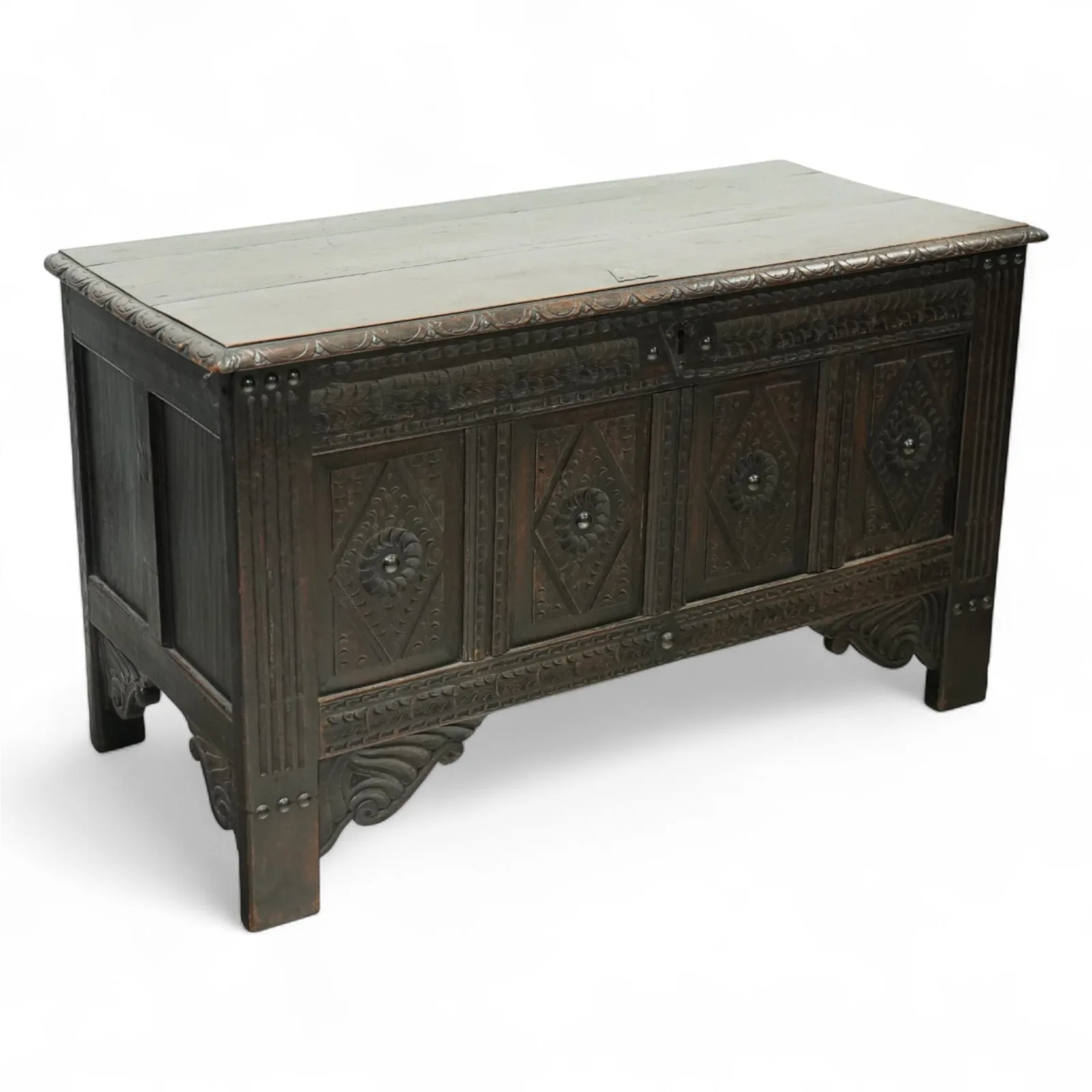
This 19th-century oak coffer presents a carefully judged synthesis of practical storage and vernacular ornament. The rectangular plank top rests upon a four-panel front, each field defined by a crisp framework and enriched with lozenges and flowerhead motifs. Such geometric relief carving derives from the decorative vocabulary of 16th- and 17th-century northern European joined furniture, and its reappearance in the 19th century reflects a broader revivalist interest in historic domestic forms. The lower rail is fashioned as a shaped apron, adding a gentle silhouette that relieves the mass of the case and echoes period precedents while signaling a later sensibility for outline and finish.
Constructionally, the coffer conforms to the established joined-chest tradition, with a framed and panelled façade that provides structural stability while accommodating movement in the oak. The integral stile feet continue the uprights to the floor, a characteristic feature of earlier models retained here for both strength and visual continuity. The planked top, of serviceable thickness, underscores the utilitarian origins of the form while offering a broad, level surface suited to domestic use. The measured, rhythmic carving—consisting of alternating lozenges and rosettes—animates the front without overwhelming the robust timbers, allowing the figure and weight of the oak to remain legible.
Within the 19th-century context, the piece aligns with what is often termed a Jacobean Revival inclination, wherein makers adapted time-honoured patterns to contemporary needs. The present example maintains a disciplined decorative program, favoring geometric motifs over more florid ornament, and thus preserves the sober, architectural character associated with earlier vernacular chests. Its proportions (H 69 × W 118 × D 53 cm) suggest versatile placement along a wall or at the foot of a bed, consistent with the longstanding domestic role of coffers for storing linens, household textiles, or seasonal goods. Lacking explicit maker attribution or regional marks, the coffer stands as a representative, well-executed 19th-century interpretation of a much older and enduring furniture type.
19th century carved oak coffer, rectangular plank top above a four-panel front carved with lozenges and flowerhead motifs, shaped lower apron and stile feet
A robust 19th-century carved oak coffer of rectangular form, the thick plank top set above a four-panel front crisply carved with alternating lozenges and flowerhead motifs. The façade is anchored by a shaped lower apron and continues into integral stile feet, lending a grounded, architectural stance. The restrained geometry of the carving evokes 17th-century vernacular prototypes while remaining sober and well-balanced. At 118 cm in width, the piece offers practical storage and a useful horizontal surface, its clean lines and substantial timbers presenting the natural character of the oak to good effect. An appealing example of revivalist taste executed with durable, workmanlike construction.